

From Buyer Specification to Export-Ready Delivery Bag Production
At Bags Factori, every custom delivery bag starts with one important question: what does the buyer need the bag to do in real delivery operations? A restaurant chain may need insulated food delivery bags for hot meals. A courier company may need durable logistics bags for parcel movement. A pharmacy network may need cleanable medicine courier bags. A delivery app may need rider backpack bags with strong branding and rider comfort.
Our delivery bag manufacturing process is designed for B2B buyers who need more than ready-made stock. We support OEM/ODM orders, custom branding, material selection, sampling, bulk manufacturing, quality inspection and export-ready packing for global buyers.
As a custom delivery bags manufacturer, Bags Factori works with buyers across food delivery, pizza delivery, courier logistics, cargo, pharmacy delivery, lab sample transport, cold chain delivery and rider fleet operations. Each order is planned around the buyer’s size, material, insulation, logo, quantity, market and delivery use case.
This page explains how we convert a business requirement into a commercial-grade delivery bag ready for bulk supply.
Manufacturing Process at a Glance
| Stage | What Happens | Buyer Benefit |
| 1. Requirement Review | Buyer shares size, use case, quantity, logo and reference design | Clear understanding before production starts |
| 2. Material Planning | Fabric, insulation, lining, zipper and structure are selected | Bag is matched to real delivery conditions |
| 3. Pattern & Design Setup | Bag shape, panels, pockets and branding areas are planned | Custom size and design accuracy |
| 4. Sample Development | Pre-production sample is made for approval | Buyer can check quality before bulk order |
| 5. Branding & Printing | Logo printing, embroidery, rubber patch or labels are applied | Private label and OEM branding support |
| 6. Cutting & Stitching | Fabric panels are cut, stitched and assembled | Consistent structure and finishing |
| 7. Quality Inspection | Size, stitching, zipper, logo and finishing are checked | Reduces risk before shipment |
| 8. Packing & Dispatch | Bags are packed in cartons for local or export delivery | Better handling for bulk B2B supply |
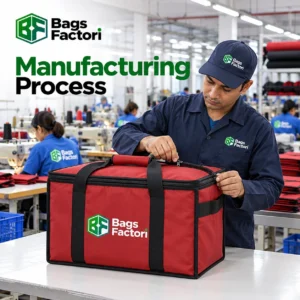
Step 1: Understanding the Buyer’s Delivery Use Case
The process begins with understanding the buyer’s business model. Bags Factori does not manufacture every delivery bag with the same structure. A pizza delivery bag, burger delivery bag, cargo delivery bag, medical courier bag and ice cream delivery bag all require different materials, insulation levels and internal layouts.
At this stage, we review the buyer’s requirement, including bag size, product type, delivery method, target market, branding requirement, estimated quantity and packing needs. A delivery app may need rider backpacks with reflective strips. A restaurant group may need insulated food bags with front logo printing. A courier company may need parcel-friendly bags with reinforced handles.
This step helps reduce confusion before sampling and bulk manufacturing. It also ensures the final bag is designed for real business use, not only for appearance.
Step 2: Material Selection Based on Performance
After the requirement review, the next step is selecting the right material. The material decision affects durability, insulation, cleaning, weight, branding and price. Bags Factori can work with multiple material options depending on the buyer’s commercial requirement.
Common materials include 600D polyester, nylon, PVC-coated fabric, tarpaulin, PP woven fabric, high-density EPE foam, thermal aluminum foil lining, waterproof lining, PP board, foam board, reinforced webbing and heavy-duty zippers.
For insulated food delivery bags, we usually focus on thermal lining, EPE foam and wipe-clean interiors. For courier delivery bags, strength and weather resistance become more important. For pharmacy delivery bags and lab sample transport bags, inner organization and cleanable lining may be required. For cargo delivery bags, reinforced stitching and stronger panels are often needed.
Step 3: Bag Design, Pattern Development & Structure Planning
Once the material direction is clear, the bag design is converted into a manufacturing plan. This includes panel sizes, opening style, pocket placement, zipper direction, handle position, internal divider layout and logo placement.
For custom OEM/ODM delivery bags, this step is very important because even a small design mistake can affect daily use. If a rider backpack is too narrow, food boxes may not fit. If a pizza bag opening is too small, loading becomes difficult. If a courier bag does not have proper handle support, it may fail during repeated use.
Bags Factori can develop different structures, including hand-carry bags, box-style delivery bags, flat pizza pouches, rider backpacks, parcel delivery backpacks, insulated cold chain bags, cargo bags and PP woven logistics sorting bags.
The goal is to create a practical design that supports the buyer’s operation, branding and bulk order plan.
Step 4: Sample Development Before Bulk Production
For serious B2B buyers, sample approval is one of the most important parts of the custom delivery bag manufacturing process. A sample allows the buyer to check material, size, insulation, logo placement, zipper quality, stitching, shape, internal space and finishing before confirming bulk production.
A sample is especially recommended for OEM/ODM orders, private-label projects, export buyers, large restaurant chains, courier companies, delivery apps, pharmacy networks and distributors.
During sample development, the buyer can review whether the bag fits their food boxes, parcels, medicine packs, documents, lab samples or delivery equipment. If adjustments are needed, they can be made before mass production begins.
This step protects both the buyer and the manufacturer by confirming the approved specification before bulk manufacturing.
Step 5: Branding, Logo Printing & Private Label Setup
Branding is a major part of the delivery bag business. Delivery bags are seen by customers, riders, restaurants, hotels, hospitals, warehouses and end users. A well-branded bag can improve trust and make the buyer’s business look more professional.
Bags Factori supports different branding methods depending on the fabric, logo style, order quantity and buyer preference. Options can include screen printing, heat transfer, embroidery, rubber patch, woven label, custom color matching and private-label packing.
For delivery apps and courier fleets, front-panel logo placement is usually important. For restaurant chains, full brand color matching may be required. For importers and distributors, private-label carton labels and product packaging can also be planned.
Every logo placement should be confirmed during sample approval to avoid production errors.
Step 6: Fabric Cutting & Panel Preparation
After sample approval and order confirmation, the production team prepares fabric cutting according to the approved pattern. Each panel must match the final dimensions because cutting accuracy affects the final shape, capacity and finishing of the bag.
Delivery bags often have multiple panels: front, back, sides, base, lid, pocket panels, straps, lining panels and insulation layers. For structured bags, PP board or foam board panels may also be prepared.
For insulated delivery bags, outer fabric, foam and inner lining must be cut according to the approved structure. For courier and cargo bags, stronger fabric and reinforced areas may be prepared separately.
This stage creates the foundation for consistent bulk production.
Step 7: Stitching, Assembly & Reinforcement
Stitching is where the delivery bag takes its final form. The panels are assembled, insulation is placed, lining is attached, zippers are fixed, handles are stitched, straps are connected and structural supports are added.
For B2B delivery bags, reinforcement is very important. Bags used by riders, couriers and warehouse teams face daily stress. Common reinforcement areas include handles, shoulder straps, backpack straps, corners, base panels, zipper ends and load-bearing seams.
Depending on the bag type, Bags Factori can include double stitching, reinforced webbing, structured base panels, padded straps, internal dividers, side pockets, document sleeves, reflective strips and front branding panels.
Strong stitching and correct assembly help improve product life and reduce replacement frequency for bulk buyers.
Step 8: Quality Control During Production
Quality control is not only a final step. It should happen during the production process as well. Bags Factori checks important production points to reduce defects before packing.
Quality inspection may include size checking, stitching review, zipper testing, logo position checking, handle strength review, inner lining inspection, insulation placement, finishing review and packing verification.
For custom export orders, consistency is very important. Buyers need the same size, same material, same color, same logo placement and same finishing across the complete order. This is especially important for restaurant chains, delivery apps, courier companies, distributors and importers.
A clear production approval process helps maintain buyer trust and reduces issues after delivery.
Step 9: Final Inspection Before Packing
Before the bags are packed, the final inspection checks whether the order matches the approved sample and buyer specification. This includes visual finishing, thread trimming, shape checking, label checking, logo placement and carton preparation.
Final inspection can cover:
Material matching
Bag dimensions
Logo placement
Zipper and closure function
Handle and strap stitching
Inner lining finishing
Overall shape and structure
Carton packing details
For B2B buyers, this step is important because delivery bags often go directly into commercial use. A restaurant chain may distribute them to branches. A courier company may issue them to riders. A distributor may resell them under its catalog. Consistency matters.
Step 10: Export Packing, Carton Labeling & Dispatch
After inspection, the order is packed according to the buyer’s requirement. Packing can include polybags, carton packing, SKU labels, buyer-specific markings, private-label packaging and export-ready carton preparation.
For global buyers, packing is not only about protection. It also supports storage, warehouse receiving, resale, branch distribution and shipment handling. Importers and distributors may require carton labels and SKU references. Restaurant chains may need packing by model, branch or quantity. Courier companies may need bulk packing for rider distribution.
Bags Factori can prepare packing according to the order type, product size, carton plan and destination market.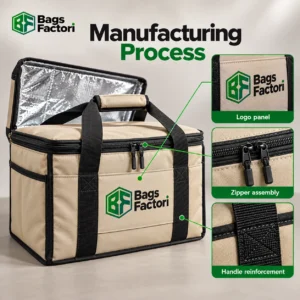
Manufacturing Process by Product Category
| Product Type | Process Focus | Common Buyer Requirement |
| Food Delivery Bags | Insulation, lining, zipper, branding | Hot food protection and restaurant branding |
| Pizza Delivery Bags | Flat structure, thermal lining, easy loading | Pizza box heat retention |
| Rider Backpack Bags | Structure, padded straps, reflective panels | Rider comfort and app branding |
| Courier Delivery Bags | Durable fabric, handles, pockets | Parcel and document handling |
| Cargo Delivery Bags | Larger capacity, reinforced base | Bulk shipment movement |
| Pharmacy Delivery Bags | Cleanable lining, compartments | Medicine and prescription delivery |
| Lab Sample Transport Bags | Organization, document pockets, clean lining | Lab sample route handling |
| Cold Chain Bags | Strong insulation, wipe-clean lining | Chilled and frozen product delivery |
How OEM/ODM Manufacturing Helps Global Buyers
OEM/ODM manufacturing allows buyers to create bags based on their own business model instead of accepting generic market designs. Bags Factori can manufacture delivery bags according to buyer-provided specifications, reference photos, logo files, colors, dimensions and packing needs.
This is useful for:
Restaurant chains launching branded delivery programs
Courier companies standardizing rider bags
Delivery apps expanding into new cities
Importers building private-label catalogs
Pharmacy networks improving medicine delivery
Cold chain buyers handling chilled products
Distributors serving multiple industries
OEM/ODM production gives buyers more control over quality, branding, materials and repeat orders.
Estimated Production Planning Guide
| Order Stage | Typical Requirement | Buyer Action |
| Inquiry | Bag type, size, quantity, market | Share basic requirement |
| Specification | Material, insulation, logo, packing | Confirm technical direction |
| Sample | Pre-production sample | Review and approve |
| Bulk Production | Cutting, stitching, branding, assembly | Production begins after approval |
| QC & Packing | Inspection and carton packing | Final checks before dispatch |
| Shipping Support | Export packing and dispatch plan | Confirm destination and freight method |
Production time depends on order quantity, customization level, material availability, logo method and packing requirement. Buyers should confirm timelines during quotation.
Why Buyers Trust a Structured Manufacturing Process
A structured process helps buyers avoid common sourcing problems: wrong size, weak stitching, poor insulation, incorrect logo placement, low-quality material, inconsistent batches and poor packing. Bags Factori works to reduce these risks by following a clear step-by-step production flow.
For global B2B buyers, this process builds confidence because every major decision is confirmed before bulk production. Material, design, branding, sample, quality and packing are all reviewed in the correct order.
This is important for buyers in the USA, UK, Germany, UAE, Saudi Arabia, Australia, France, Italy, Netherlands, Spain, South Africa and Mexico, where delivery standards, buyer expectations and market competition are high.
Frequently Asked Questions
1. How does Bags Factori start a custom delivery bag order?
The process starts with buyer requirements. Share your bag type, size, quantity, logo, material preference, target use and reference image. Bags Factori then reviews the requirement and suggests a suitable manufacturing direction.
2. Do you make samples before bulk production?
Yes. Sample development is recommended for custom OEM/ODM orders. It helps confirm material, dimensions, logo placement, stitching, insulation and overall finishing before mass production.
3. Can I customize the material and insulation?
Yes. Buyers can choose from different fabric, lining and insulation options depending on the bag type. Insulated food delivery bags, pharmacy bags, cold chain bags and courier bags can all be customized.
4. Can Bags Factori manufacture private-label delivery bags?
Yes. OEM/ODM and private-label manufacturing are available. Buyers can request custom logo printing, rubber patches, embroidery, custom colors and buyer-specific packing.
5. What quality checks are performed during manufacturing?
Quality checks may include size verification, stitching review, zipper testing, logo placement check, lining inspection, structure review and packing inspection.
6. Can the same design be produced again for repeat orders?
Yes. Once a buyer approves a design and specification, repeat orders can be produced using the same size, material, logo placement and packing details.
7. Do you support export packing?
Yes. Export packing can include carton packing, polybags, SKU labels, buyer-specific carton markings and private-label packaging depending on the order requirement.
8. Can you make different bag types under one order?
Yes. Buyers can combine different delivery bag categories such as food delivery bags, pizza bags, courier bags, rider backpacks, pharmacy bags and cold chain bags depending on MOQ and production planning.
9. What information is needed for a quotation?
Please provide bag type, required size, quantity, logo file, material preference, delivery use case, reference photo and destination market. This helps prepare a more accurate quotation.
10. How do I avoid mistakes in bulk production?
The best way is to approve a pre-production sample before bulk manufacturing. This allows both buyer and factory to confirm material, size, structure, branding and finishing before mass production.